
By Robert Coleman
October 26, 2026
Back in August, an Outdoor Life reporter tried calling Silencer Shop about suppressor transfers after the Texas ruling and ended up 52nd in the phone queue. In the same story, Brandon Maddox of Silencer Central described who was actually buying. "It's not necessarily repeat customers," he said. "It's been new customers who've been waiting for this day to happen." He figured some of them didn't want the government fingerprints and some had always told themselves they'd buy one if the process ever went away. By his read, that crowd was most of the people buying suppressors right then.
That was the narrow version, covering members of the groups that sued and customers of the plaintiff companies, in states without their own laws stacked on top. On October 9 the Bureau of Alcohol, Tobacco, Firearms and Explosives (ATF) widened it. ATF said it will not enforce the National Firearms Act (NFA) requirement to apply for and receive approval before making or transferring suppressors, short-barreled rifles and shotguns, and "any other weapons," and it will not enforce NFA registration or tax-stamp requirements for those items either. Dealers still complete a Form 4473, run the background check, keep records, and follow the Gun Control Act. Six days later The Outdoor Wire quoted one manufacturer: "Every major manufacturer in the United States is out of inventory." That maker put its own ramp back up at 90 to 120 days.
What the numbers say so far
RetailBI's Q3 2026 report, built on data from more than 2,000 retailers, had suppressor units up 178.6% year over year. New firearm units fell 7.8% in the same quarter, and firearm revenue slipped just 0.8%, with average selling prices up 7.6%. Watch the calendar on that one. Q3 closed at the end of September, before the nationwide guidance, so none of the 178.6% comes from the October change. The $200 tax had already gone to zero on January 1, and the August ruling covered a slice of buyers. Whatever October does gets stacked on top.
So the category that grew while guns shrank is about to get a second shove, with most of the makers already backordered. A brand can look at an empty shelf and decide advertising can wait until Q1. The instinct makes sense (nobody likes paying for clicks on a product they can't ship), but the first-time buyer stuck on a waitlist is still deciding whose waitlist to join, and that shortlist gets built now.
The state map still matters
Federal non-enforcement does not rewrite state law, and ATF said so in its own guidance. On The Reload's podcast, firearms attorney Gilbert Ambler walked through NFA mirror laws in states like Virginia, Pennsylvania, Maryland, and North Carolina, which may still make registration necessary for people there. He put some estimates of how many such laws exist at around 15. This isn't legal advice, and the rules really do vary by state. For a media plan the practical version is simple: get the state list from counsel and geo-target to it, so nobody in a mirror-law state gets an ad promising a same-day, 4473-only pickup.
Who reads the gun blogs
Endemic media is very good at one audience. NSSF (the National Shooting Sports Foundation) ran a piece in December 2024, written by an agency founder, describing how brands pushed off the big platforms turned to "closed-wall" ecosystems of firearm-specific sites, and how that kept ads "contained within a narrow audience that typically has significant brand loyalty." That is the person shopping for a second can or a threaded barrel for a rifle they already own. Ammunition Depot's CEO told Tactical Retailer his company is already expanding its threaded-barrel selection for exactly that customer. Endemic placements should keep catching that buyer.
The sideline buyer Maddox described is a different person. Some of them read the forums, sure. A lot of them spent years deciding the whole process wasn't worth it, which is a strange hobby to research nightly. And first-time gun buyers in general keep drifting away from the forum regular's profile. NSSF's latest first-time buyer study found nearly three-quarters of the first-time buyers it sampled from 2021 to 2024 were women, up from slightly less than half in its 2020 sample (study samples, not national shares, and gun buyers, not suppressor buyers specifically). If the plan only buys gun blogs, it is mostly paying to reach people who already knew suppressors existed and already had an opinion about the paperwork.
Where the money goes
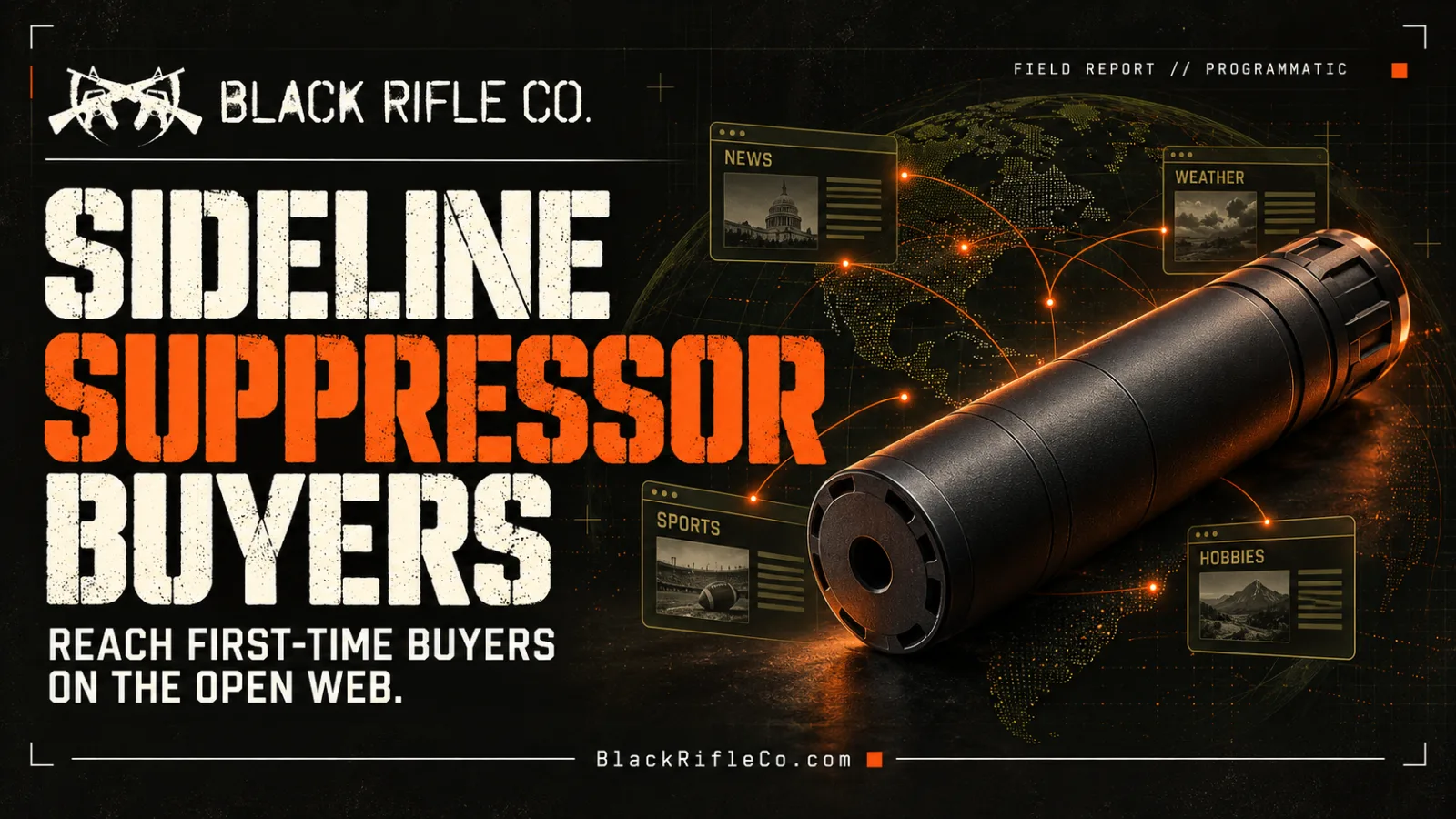
Keep endemic funded for upsell and repeat purchase. Endemic does that job well, and the new-buyer budget should not come out of it. The first-purchase money belongs where a first-time buyer spends an ordinary day: news, weather, local sports, the hobby sites that have nothing to do with guns. Programmatic display can reach those pages when you have a demand-side platform (DSP) and a supply path that will actually take a suppressor creative onto them, which is the hard part. The argument for funding that reach at efficient scale is already written, and the case that endemic mostly collects demand someone else created is in endemic is harvest, not growth.
Follow-up ads to people who already visited a product page still belong in the plan. Serve them off the gun blogs too, on pages where the ad isn't one more suppressor banner in a feed full of them.
Brands that build the habit of reaching people outside the category get to sell this wave of buyers their first can, and then the endemic plan sells them the second one.
Sources
- RetailBI, "RetailBI Q3 2026 Report Highlights Shifting Consumer Demand and Growth Across Key Shooting Sports Categories," The Shooting Wire, October 21, 2026, https://www.shootingwire.com/releases/2026/10/retailbi-q3-2026-report-highlights-shifting-consumer-demand-and-growth-across-key-shooting-sports/
- Bureau of Alcohol, Tobacco, Firearms and Explosives, "ATF issues guidance on National Firearms Act transfers for short-barreled rifles, short-barreled shotguns, suppressors, and certain other firearms," October 9, 2026, https://www.atf.gov/news/press-releases/atf-issues-guidance-national-firearms-act-transfers-short-barreled-rifles-short-barreled-shotguns-suppressors-and-certain-other-firearms
- Sarah N. Lynch, "DOJ says it won't enforce provisions of 1934 firearms law that were gutted by court ruling," CBS News, October 9, 2026, https://www.cbsnews.com/news/justice-department-atf-gangster-weapons/
- TR Staff, "What the ATF's New NFA Enforcement Shift Means for Retailers" (interview with Ammunition Depot CEO Dan Wolgin), Tactical Retailer, October 25, 2026, https://www.tacretailer.com/news/atf-nfa-enforcement-shift-retailers
- Natalie Krebs, "'Confusing for Everyone.' Suppressor Sales Boom Even as Many Gun Shops Wait for Federal Guidance After Deregulation Ruling," Outdoor Life, August 21, 2026, https://www.outdoorlife.com/guns/suppressor-deregulation-chaos/
- Alex Miceli, "Suppressor Makers Selling Out After Friday's ATF Guidance Release," The Outdoor Wire, October 15, 2026, https://www.theoutdoorwire.com/features/2026/10/feature-2-suppressor-makers-selling-out-after-fridays-atf-guidance-release/
- Stephen Gutowski, "Podcast: How NFA Mirror Laws Impact Silencer, SBR Sales (ft. Firearms Attorney Gilbert Ambler)," The Reload, October 25, 2026, https://thereload.com/podcast-how-nfa-mirror-laws-impact-silencer-sbr-sales-ft-firearms-attorney-gilbert-ambler/
- Jeff Marcoux, "Geofencing: Why Every Gun Store and Range Should Be Using It," NSSF, December 12, 2024, https://www.nssf.org/articles/geofencing-why-every-gun-store-and-range-should-be-using-it/
- Jenn Jacques, "Women Are Surging Among New Gun Owners as Self-Defense Reshapes Firearm Ownership," NSSF, October 19, 2026, https://www.nssf.org/articles/women-are-surging-among-new-gun-owners-as-self-defense-reshapes-firearm-ownership/