
Call it efficient scale
By Robert Coleman
September 16, 2026
I was listening to a podcast when an Editor in Chief at a major advertising technology (AdTech) publication said something that stopped me cold. His line, as I heard it, was that hopefully we are finally letting go of this idea of cheap reach in programmatic.
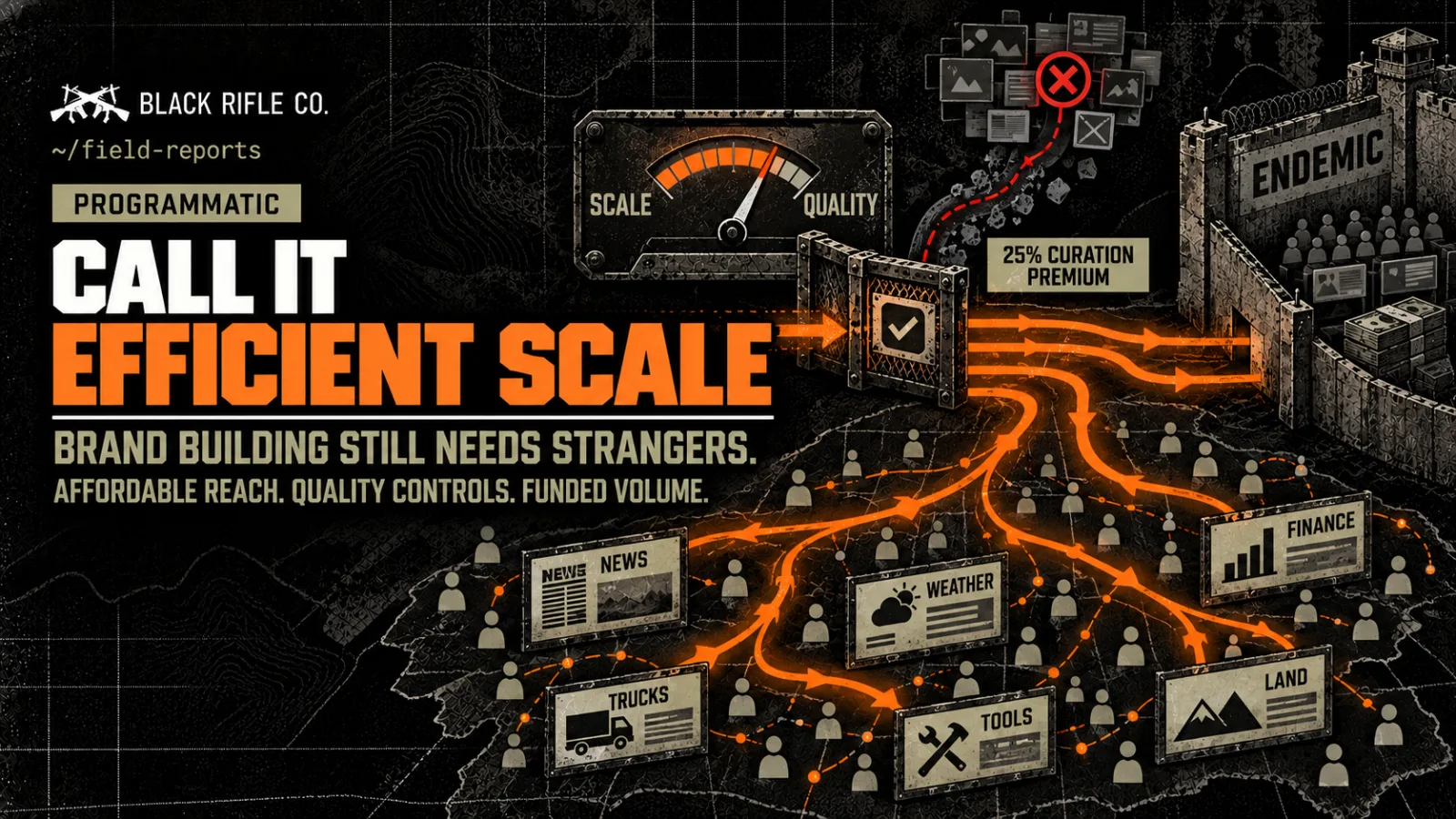
Cheap reach. That is the industry label. I am going to rename it right here, because media buyers buy on perception as much as they buy on price. Call it efficient scale: the ability to put a brand in front of a lot of real people at a cost per thousand impressions (CPM) you can actually fund, week after week, without pretending every impression sits on a homepage above the fold.
I disagree with that podcast hope. Absolutely.
What efficient scale actually buys you
Brand building still needs strangers. WARC's January 2026 briefing on targeting versus reach puts it plainly: tight targeting can help short-term activation, and reach tends to favor long-term brand growth. That matches how Les Binet and Peter Field framed the problem for the Institute of Practitioners in Advertising (IPA) years ago in The Long and the Short of It. Short-term online metrics make a tidy dashboard. They are a thin diet if you starve the longer memory work.
Byron Sharp's Ehrenberg-Bass line is even more blunt on the buyer side. Mental availability is the chance someone notices, recognizes, or thinks of your brand in a real buying situation. You build that by refreshing memory structures across a lot of category buyers, including the light ones who show up once or twice a year. Those people do not live inside your customer relationship management (CRM) system. You have to go get them.
Efficient scale is how a media plan pays for that trip. You buy volume you can afford. You keep the brand present across more occasions than a premium-only plan will ever fund. You accept that some placements will be ordinary open-web inventory. Ordinary is still useful when the alternative is silence.
Where the critiques stop short
Yes, the open web has junk. Digiday and AdExchanger spent 2023 documenting made-for-advertising (MFA) sites, the MFA mess, and the industry's sudden urge to purge "cheap reach." Chris Kane at Jounce has been clear that a lot of that supply is human traffic chasing viewable, brand-safe, low-CPM bids. When buyers tell a demand-side platform (DSP) to chase cost-per-viewable-impression, the system finds MFA. When buyers tell it to chase sales and real outcomes, the system runs the other way.
Fraud is a separate problem. Brand safety is a separate problem. Both deserve filters, inclusion lists, and adults in the room. None of that proves that affordable reach is a dead idea. It proves that lazy key performance indicators (KPIs) buy lazy supply.
Bill Duggan at the Association of National Advertisers (ANA) told Digiday some advertisers still shrug and say they get cheap reach from MFA. Fair. Other advertisers want curation and will pay a bit more for cleaner packages. DataBeat's October 2024 U.S. programmatic look put curated inventory roughly 25 percent higher in CPM than non-curated on average across supply-side platforms (SSPs) that offer curation. That premium is the point. You can buy tighter. You can also keep a funded scale layer so the brand still shows up outside the shortlist.
Efficient scale is reach you can afford at volume. Quality controls still belong in the buy. Quality that prices you out of volume is a different problem.
Restricted categories feel this harder
If you sell soap, you can argue about Meta versus connected TV (CTV) versus open web until the coffee gets cold. If you sell firearms, ammunition, or a lot of related product, the big consumer pipes are already closed or half-closed.
Google Ads still restricts guns and related products. Shooting Industry walked Meta again in 2026: paid ads that sell the handgun, the ammo, the suppressor, or the weapon optic stay out. Classes and open houses can still run. That leftover lane fills a Tuesday night orientation. It does not replace national product reach.
The National Shooting Sports Foundation (NSSF) spelled it out in December 2024. Brands pushed into "closed-wall" endemic sites stay visible inside a narrow, loyal circle. Limited reach. Fine for harvest. Thin for growth. I already wrote that endemic is harvest, not growth. New customers are still on the rest of the open web.
When Meta and Google product ads are closed, affordable open-web reach matters more. Efficient scale through programmatic display, on pipes that will actually take a firearms creative onto non-endemic pages, is one of the few ways a restricted-category brand keeps introducing itself to people who do not already live on gun blogs.
How I would plan it
Fund a scale layer you can keep on. Aim for net new people, light buyers, and category entry occasions, not another week of hammering the same heavy buyers at a luxury CPM. Put outcome and quality rules on the buy so MFA does not become the entire plan. Keep endemic for stock-keeping unit (SKU) harvest. Keep the leftover social lane for events if it still clears policy.
Then stop apologizing for the CPM. The podcast hope was that the industry would "let go" of cheap reach. Firearms marketers who take that advice too literally will let go of the only scale they can still buy.
I am keeping efficient scale in the plan.
Sources
- WARC, "What we know about targeting vs reach," January 7, 2026, https://www.warc.com/en/article/what-we-know-about-targeting-vs-reach-221197401a084269a62ffa874aceae66
- Les Binet and Peter Field, The Long and the Short of It, IPA, https://ipa.co.uk/knowledge/publications-reports/the-long-and-the-short-of-it
- Byron Sharp, "Mental availability is not awareness, brand salience is not awareness," Ehrenberg-Bass / marketingscience.info, https://marketingscience.info/news-and-insights/mental-availability-is-not-awareness-brand-salience-is-not-awareness
- Seb Joseph, "The MFA uproar puts curation of programmatic advertising in the spotlight," Digiday, August 28, 2023, https://digiday.com/marketing/the-mfa-uproar-puts-curation-of-programmatic-advertising-in-the-spotlight/
- Seb Joseph and Kayleigh Barber, "The case for and against made-for-advertising sites," Digiday, August 14, 2023, https://digiday.com/marketing/the-case-for-and-against-made-for-advertising-sites/
- James Hercher, "Why MFA Is Ad Tech's Biggest Problem (But Also Its Easiest To Solve)," AdExchanger, October 2, 2023, https://www.adexchanger.com/programmatic/why-mfa-is-ad-techs-biggest-problem-but-also-its-easiest-to-solve/
- DataBeat, "US Programmatic Trends, October 2024," November 18, 2024, https://databeat.io/blog/us-programmatic-trends-october-2024/
- Google Ads Help, "Guns, gun parts, and related products," https://support.google.com/adspolicy/answer/16489226?hl=en
- Taylor Smithfield, "Wait, You Can Run That Ad?," Shooting Industry Magazine, July 2026, https://shootingindustry.com/dealer-advantage/wait-you-can-run-that-ad/
- Jeff Marcoux, "Geofencing: Why Every Gun Store and Range Should Be Using It," NSSF, December 12, 2024, https://www.nssf.org/articles/geofencing-why-every-gun-store-and-range-should-be-using-it/