
You're Paying Ten Gun Influencers to Reach the Same Guy
You're Paying Ten Gun Influencers to Reach the Same Guy
By Ben Owen
Every marketing director in this industry has run the same play.
You build a roster. A couple of big GunTube channels, three or four mid-tier reviewers, a competitive shooter with a loyal following, and a concealed carry guy whose comment section actually argues about your product. You pay them all. You add up their subscriber counts, you put the number in a deck, and you present a reach figure to your CEO that looks enormous.
Then you look at the quarter and the new customer count barely moved.
You are not bad at your job. You bought exactly what you thought you were buying. The problem is that the number in your deck was never a reach number. It was the same audience counted nine times.
Influencer numbers are getting worse every year
Start with the general market, because the firearms category is downstream of it.
Rival IQ's Q1 2026 analysis across 2,800 brand and creator accounts in 14 industries put the platform-wide average engagement rate at 0.54 percent, down 22.9 percent from 0.70 percent the year before. Instagram influencers above five million followers dropped to roughly 1.97 percent, a 24 percent year-over-year decline in the top tier. On X, influencer engagement fell 48 percent year over year, the steepest slide among the major platforms.
The larger the creator, the worse the trend. One 2026 analysis put mega-influencers at 1.21 percent engagement against 3.86 percent for micro-creators. The tier you are paying the most for is the tier degrading the fastest.
Underneath that sits an audit problem the industry has mostly stopped talking about. A SociaVault review of 100,000 creator accounts found that 37.2 percent of influencer followers showed signs of being fake, purchased, or otherwise inauthentic. A 2026 global audit put fraudulent account activity at 41.3 percent, with AI-generated bot networks responsible for 58 percent of detected fraud, up 34 percent from the prior baseline.
And the supply side is flooding. Goldman Sachs counted roughly 67 million people globally identifying as creators in 2025 and projects 107 million by 2030. Only about 4 percent clear $100,000 a year, a share Goldman expects to fall to 2.5 percent as the pool grows.
More creators, fewer real followers per creator, less engagement per follower. That is a channel in the late stage of its efficiency curve, and no amount of relationship building fixes arithmetic.
Nobody puts the overlap on the invoice
Now the part that should make you pull up your last campaign.
HypeAuditor's audit work found that two influencers in the same niche share, on average, 15 to 40 percent of their audience. In tight verticals - skincare, fitness, anything where the community is dense and the creators all know each other - that figure spikes to 50 to 65 percent.
Firearms is not a loose vertical. It is one of the tightest communities on the internet. The same guy who subscribes to a rifle reviewer subscribes to the optics guy, the ammo guy, the holster guy, and the 2A commentary channel, because he is a hobbyist and hobbyists consume everything in their hobby. Discovery algorithms make it worse by design. On TikTok, 78 percent of users find creators through the For You Page, which is a machine built specifically to cluster identical audiences around adjacent creators.
Run the math on what that does to a budget.
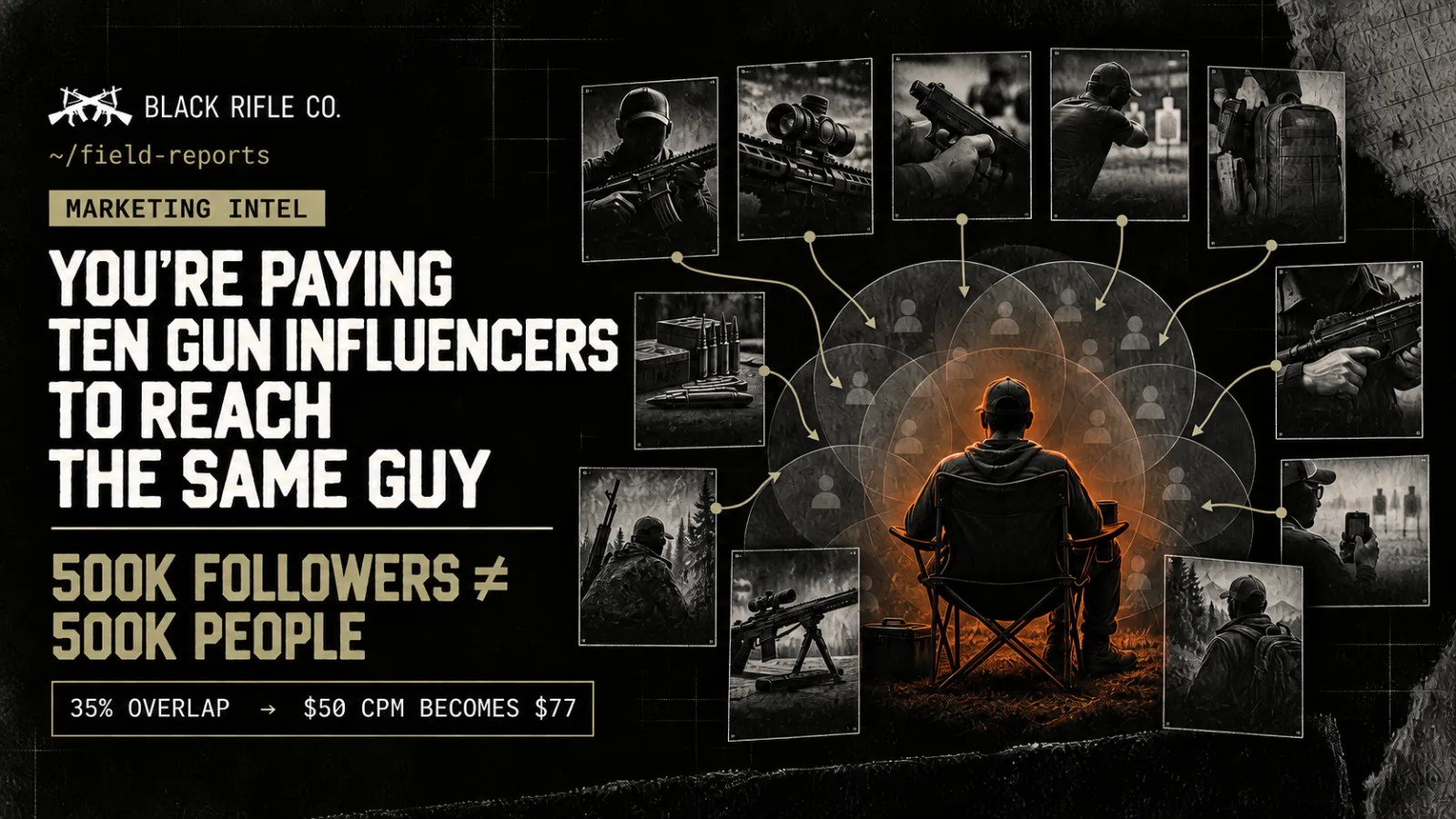
Five creators at 100,000 followers each looks like 500,000 reach. At 35 percent overlap, unique reach is roughly 325,000. A campaign you priced at a $50 CPM is actually running at a $77 effective CPM per unique person. Cut the overlap to 10 percent and unique reach climbs to 450,000 and your effective CPM falls to about $56, a 27 percent efficiency gain on the exact same spend.
Nielsen research has consistently found that redundant reach wastes 20 to 30 percent of total digital media spend. Influencer Marketing Hub's 2025 work put the loss at 15 to 25 percent of campaign budget for brands that never run an overlap analysis before booking.
Almost nobody in this industry runs one. Rosters get built on follower counts, engagement screenshots, and who answered the email.
In a vertical where overlap credibly runs north of 50 percent, a ten-creator endemic buy can easily deliver the unique reach of three or four. You paid ten invoices. You walked into the same room ten times and paid at the door every time.
Endemic media does the exact same thing, just quieter
Influencers get all the attention on this. The publisher networks do it too.
I am in a joint venture with Bleecker Street Publications, which owns fourteen of the most established properties in this category. Athlon Outdoors. Ballistic. Combat Handguns. Personal Defense World. Tactical Life. GAT Daily. Skillset. If you have ever run an endemic firearms campaign, you have run it on those pages.
And I will tell you what Bleecker Street tells its own clients: the endemic web is finite, every brand in the category is buying the same finite inventory, and the crowd drives the price up without adding a single new human being to the pool.
Layer influencers on top of endemic and the overlap compounds. The guy reading the gun blog is the guy watching the gun channel. He is one person. You have now paid for him three ways and called it an integrated campaign.
And YouTube can turn it all off whenever it feels like it
The efficacy and overlap math would be reason enough. The firearms category gets a third penalty the rest of the advertising world does not.
YouTube has been tightening the screws on gun content since 2016 - demonetizations, in-video sponsorship restrictions, bans on links to retail pages, and age-gating on entire categories of video. When Demolition Ranch, the largest channel in the space, got age-restricted, its operator said publicly that restricted videos pulled roughly 40 percent of normal views, because most viewers are not logged in.
You can build your entire distribution strategy on creators, and one policy update in Mountain View can cut your reach by more than half without a phone call.
Your demand should never sit on somebody else's policy page.
What real reach looks like
None of this means fire your creators. Influencers are excellent at what they are actually good at, which is credibility and frequency inside a community that already knows you. That is a conversion asset. Treat it like one and stop asking it to be a reach asset, because the math says it cannot be.
Reach is a different buy, and it lives outside the community.
Max Precision Reach operates a purchase-intent audience of 18 million active firearms shoppers, covering all fifty states and 3,143 counties. It is trained on real purchase events instead of survey panels, monitored across more than 2,500 intent and sentiment signals, and refreshed continuously. We have served north of 500 million firearms ad impressions and we measure campaigns on incremental lift, currently running at six times.
That audience does not get sold to you as an undifferentiated blob called gun owners. It resolves into what you actually sell against: waterfowl and upland, western big game, whitetail, competition, concealed carry and EDC, first-time buyers, female buyers, collectors and C&R, reloaders and precision, home defense, suppressor and NFA, predator and varmint. Slice any of it to the state, the county, the category, or the price band.
We hold no customer identity data and we never track a person. The audience is anonymized and behavioral, which is exactly why it survives in a category where identity-based targeting is what gets brands banned and dragged into a headline.
And the placements sit on the open web, where your buyer spends the other twenty-three hours of his day. Morning news. The finance page at lunch. Trucks, tools, and land on the weekend. Brand-safe, frequency-capped, no made-for-advertising junk, no below-the-fold graveyards.
There are 88 million gun owners in this country, and the endemic ecosystem talks to a small, heavily duplicated slice of them. The rest have never heard of you.
Run the numbers before you sign another creator deal
Pull your last twelve months of creator and endemic spend. Then answer two questions honestly.
What percentage of that budget reached somebody who did not already own one of your products?
And what was your real cost per unique person, after overlap?
If either number makes you uncomfortable, nothing actually failed. You gave a conversion channel a reach job it was never built to do.
We can show you where the rest of your market is. Tell us what you sell and who buys it.
Sources: Rival IQ Q1 2026 engagement benchmarks; HypeAuditor audience overlap research; Nielsen redundant reach findings; Influencer Marketing Hub 2025 campaign budget analysis; SociaVault creator account audit; Goldman Sachs creator economy projections; NBC News reporting on YouTube firearms policy enforcement; 2026 National Firearms Survey, William English, Georgetown University.