
Gun Companies Are Underspending on Brand, and the Numbers Aren't Close
Gun Companies Are Underspending on Brand, and the Numbers Aren't Close
By Ben Owen
In the last piece, we talked about overlap. You pay ten creators and reach the same audience ten times.
This one is about the budget behind that problem. Money that should go to building your brand with new buyers is going somewhere else, and the gap between what this industry spends and what the big consumer brands spend is wider than most marketing directors realize.
What the big consumer brands spend
Start with the baseline. Gartner's 2025 CMO Spend Survey found marketing budgets held flat at 7.7% of overall company revenue, the same as the year before. That survey leans heavily toward companies reporting annual revenue of over $1 billion.
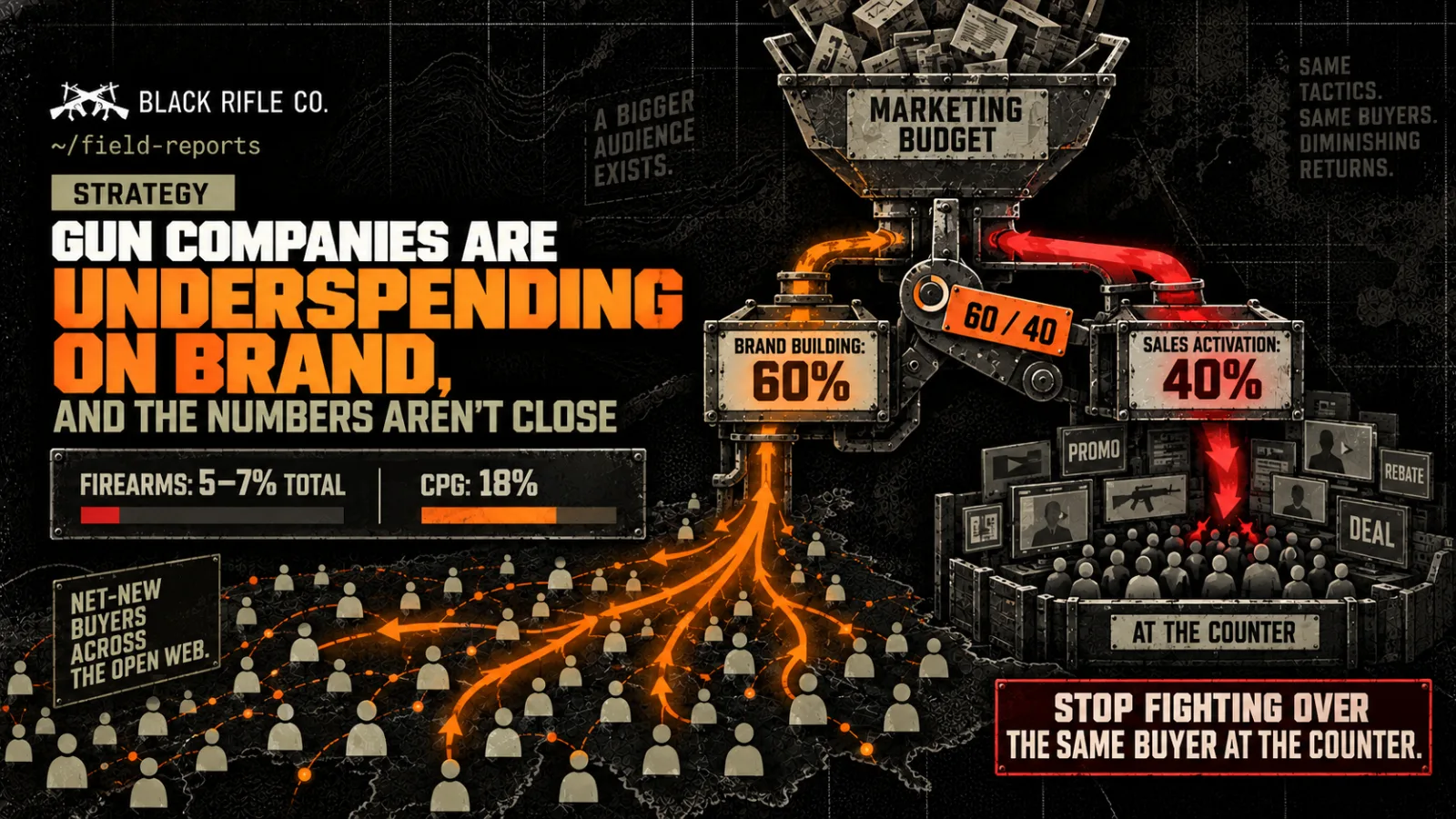
Consumer packaged goods runs much higher. Industry benchmarks put consumer packaged goods at roughly 18% of revenue, driven by the fact that staying visible in a crowded retail environment is continuous and expensive. Some estimates go higher, with CPG brands at 20 to 25% of revenue.
Firearms buyers also walk into a crowded retail environment. They stand at a counter looking at a wall of options, and a dealer is talking in their ear.
What gun companies spend
Look at Ruger, one of the biggest names in the business and one of the few that reports publicly.
In 2025, Ruger's total net sales were $546.1 million and its selling expenses were $39.1 million. That puts the entire selling line at about 7% of revenue. That line covers more than advertising. It includes trade shows, sales staff, shipping, and promotions. Ruger itself said increases in promotional and marketing initiatives were largely offset by decreases in spending on industry shows, personnel costs, and shipping expenses.
So one of the strongest brands in the industry spends less on selling, top to bottom, than the average big company spends on marketing alone. Against CPG, it spends less than half.
Where the gun money actually goes
A brand dollar is spent putting your name in front of someone who isn't shopping yet, so you're the one they remember when they are. A performance dollar is spent closing someone who's already at the counter.
The research says you need both, weighted toward brand. Les Binet and Peter Field's work on the IPA Databank found that roughly 60% of marketing investment should fund long-term brand building and roughly 40% should fund short-term sales activation. Even the big spenders miss that mark. The 2025 CMO Survey found actual spending runs 31.2% brand to 68.8% performance.
Now look at how this industry buys. Endemic placements, creator deals, rebates, and promos are all performance money pointed at people who already own guns and already follow the category. Ruger's own 10-K describes a market shaped by aggressive promotions, discounts, rebates, and the extension of payment terms offered by the Company's competitors.
That's a category fighting over the same buyer at the counter.
Why brand spend got squeezed out of this industry
Every other consumer category builds brand on the big platforms. Gun companies mostly can't. Google and Meta shut the door, broadcast is expensive and restrictive, and the mainstream reach channels a CPG brand takes for granted aren't available.
So the budget went where it could. It went into endemic media and creator rosters, which talk to the same heavily duplicated slice of the market we covered in the overlap piece.
That leaves the out-of-market buyer mostly unreached. The research on this is blunt. Brand spending exists because at any moment most buyers are not buying, and brand work plants the memory that surfaces when those buyers eventually enter the market.
If you never reach those people before they're ready to buy, they show up at the counter with no reason to pick you.
Put real numbers on it
Take a hypothetical brand doing $100 million a year.
At a CPG-style budget of 18%, that's $18 million in marketing. At a 60/40 split, $10.8 million of it goes to building the brand with people who aren't shopping yet.
At a firearms-style budget of 5 to 7%, the same brand has $5 to $7 million total. If most of that goes to endemic, creators, and promos, the money left for reaching new people might be well under a million.
That's a brand-building budget roughly a tenth the size, spent in a market where 26 million people became new gun owners since 2020 and most of them have never been reached by any brand at all.
Reach at scale costs less than it used to
The old excuse for skipping brand work was cost. Reaching millions of people meant TV, and TV meant big budgets and a network standards department deciding whether your ad could run.
Programmatic changed that math. You can put your brand in front of millions of verified, purchase-intent adults across the open web, in the places they read, watch, and shop, at CPMs that would've been unthinkable for broad reach ten years ago. And you can do it without asking Google or Meta for permission.
It's the brand-building channel this industry never had.
Run this number before your next budget meeting
Pull last year's marketing spend. Split it into two piles.
The first pile is everything aimed at people who already follow the category, including endemic media, creators, rebates, and promos. The second pile is everything aimed at people who don't know you yet.
If the second pile is smaller than the first, you're running a performance-heavy plan in a market where the bigger opportunity is the people you've never talked to.
We can show you where they are and what it costs to reach them. Tell us what you sell and who buys it.
Sources: Gartner 2025 CMO Spend Survey; Deloitte/Duke/AMA CMO Survey 2025; Binet and Field, The Long and the Short of It (IPA); LinkedIn B2B Institute; Sturm, Ruger & Company Form 10-K for fiscal year 2025.