
Every Banned Vertical Writes the Same Playbook
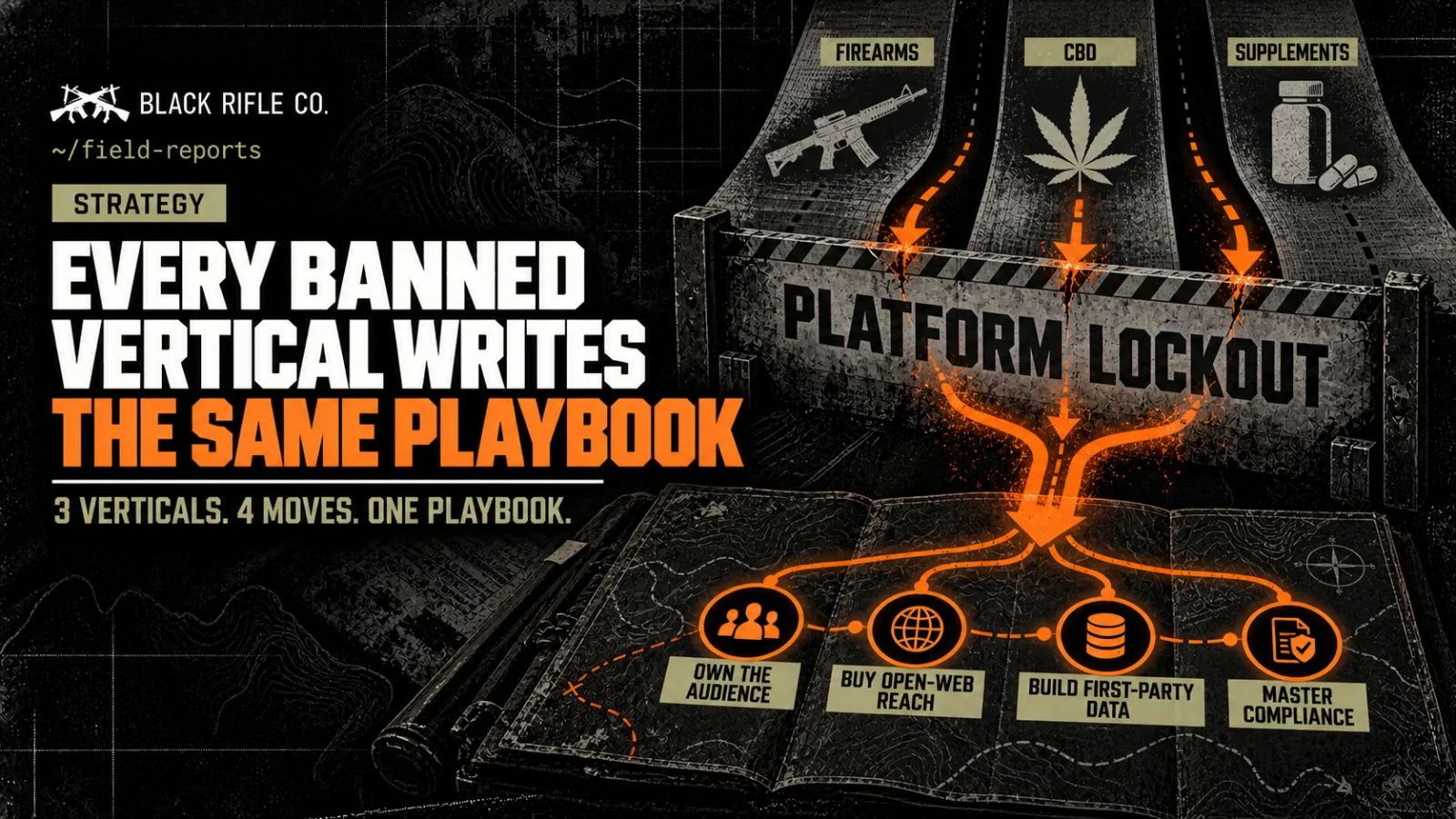
Firearms marketers tend to talk about the platform lockout as if it happened to us alone. It did not. Ask anyone who has tried to run paid social for a CBD brand, or anyone who has watched a supplement company's ad account get suspended for the fourth time in a year. Three big verticals hit the same wall: firearms, CBD, and supplements. Different products, different regulators, different customers.
What makes the comparison useful is not the shared grievance. It is that the three industries hit the wall at different times, from different directions, and then, without talking to each other, converged on the same four survival moves. When operators who do not share notes keep arriving at the same playbook, that is not fashion. That is the terrain telling you what works.
Three collisions, three timelines
CBD was born banned. Even after hemp was legalized federally, Meta and Google kept the category out of paid placements, and for practical purposes they still do. That sounds like the worst draw, and in the short term it was. But it had a strange side effect: CBD brands never developed the habit of buying customers from a feed. There was no golden age to remember and no pixel to mourn. From day one they built email lists, affiliate programs, and content SEO, because those were the only doors that opened. They went straight to owned audiences, not because their founders were visionaries, but because there was no alternative. You cannot grieve what you never had.
Supplements got a different deal, and arguably a worse teacher. They were never banned outright. They live in permanent probation. Accounts flagged without explanation, creatives rejected on Tuesday that ran fine on Monday, policy language reinterpreted overnight. Any supplement operator with a few years in the category has lost an ad account and learned the real lesson: platform access is a rental, and the landlord does not return calls. So they diversified early. Not out of principle. Out of scar tissue. The typical serious supplement brand runs email, SMS, affiliate, influencer whitelisting, and open web media side by side, because it has been burned by every single channel at least once.
Firearms got the full dramatic arc. Years of genuine access to the big platforms, real campaigns, real pixels, real lookalikes. Then the door closed. And of the three verticals, we have spent the longest grieving. You can still walk a trade show floor today and hear someone say "when Meta comes back." Some brands have been saying it for the better part of a decade. Waiting for reinstatement is not a strategy. It is a mourning period with a media budget attached.
The playbook they all wrote independently
Strip away the category specifics and the same four moves show up in all three verticals.
-
Own the audience relationship. Email and SMS are the only channels in your stack that no policy team can revoke. CBD brands figured this out first and it shows: for many of them the list is not a marketing channel, it is the business. If the majority of your revenue cannot be reached without someone else's permission, you do not own your revenue.
-
Buy reach where the rules are a contract. On the open web, through programmatic and direct placements, the policies are negotiated, written down, and enforced by people you can call. That is a categorically different risk than an algorithm reinterpreting your existence overnight. The audience is there, too. There are roughly 18 million active firearms shoppers in the market, and they read news, check weather, and browse gear reviews on the open web like everyone else.
-
Invest in first-party data. Nobody is going to hand you a pixel and a lookalike engine, so you build your own signal: capture on site, clean CRM data, and measurement you control. It is slower than the plug-and-play version the mainstream gets, but it is yours, and it holds up under scrutiny. Measured against incremental lift rather than a platform grading its own homework, this kind of program can genuinely perform; we have measured a 6x return on that standard.
-
Treat compliance fluency as a moat. Knowing exactly what you can say, where you can say it, and which partners will actually run it is expensive knowledge. That is the good news. Every competitor has to pay the same tuition, and most will pay it slowly. The supplement brands that internalized compliance ship campaigns in days that their competitors spend months getting cleared. In a restricted category, speed through the rules is a competitive weapon.
Banned early is an advantage
Here is the part nobody in our industry wants to hear. Line the three verticals up by when they lost access, and the durability of their channel mixes runs in the opposite order. CBD, banned from day one, built businesses with no single point of failure. Supplements, perpetually unstable, diversified early and stayed diversified. Firearms, banned last, still has the largest share of brands structurally organized around a channel they no longer have, running skeleton marketing while they wait for a reinstatement that has no announced date and no reason to arrive.
The handicap was never the ban. The handicap is the memory of access. Muscle memory from the Meta years keeps pulling budgets, org charts, and expectations back toward a door that is closed, and every quarter spent waiting is a quarter a competitor spends building a list.
So the practical question for a firearms brand is simple. If Meta reinstated gun ads tomorrow, would you reorganize your marketing around it? If the honest answer is yes, then your current channel mix is a placeholder, and your growth plan is a bet on someone else's policy team changing its mind. The brands that will own this category in five years are acting like CBD acted in year one: as if they were born banned, because for all planning purposes, they were.