
Your Ad Stack Is Quietly Building a Gun Registry
The firearms buyer is the most privacy-sensitive customer in retail, and it is not close. This is a customer who pays cash on purpose. Who knows that the 4473 he filled out stays in the dealer's file cabinet, and knows why: federal law prohibits a central registry of gun owners, and this industry has spent decades keeping it that way. When a merchant category code for firearms retailers was approved in 2022, he read it correctly as an attempt to assemble a purchase log out of credit card data, and within a year several states had banned its use. That is your customer. He keeps a working model of every database he appears in.
Now hold that customer in your head and reread the last martech pitch that landed in your inbox. Identity resolution. Person-level targeting. Onboard your CRM. Enrich your customer file. In any other category, this is Tuesday. In this category, every one of those phrases describes the same object: a list of identified gun buyers, stored on a vendor's servers, growing every month. The industry fought for half a century to make sure the government could never build that object. Then a marketing team signs a vendor agreement and builds it privately, indexed by email address, with a dashboard on top.
What a list can do to you
Three things, none of them good.
It can leak. In 2022, the California DOJ briefly published the personal information of the state's concealed carry permit holders: names, dates of birth, home addresses. It was an accident. The apology was prompt. The data is still out there. Every person-level record a vendor holds about your buyers is a candidate for the same headline with your brand's name in it, sitting on infrastructure you have never audited.
It can be demanded. Anything that exists can be subpoenaed. Civil suits, discovery requests, agency inquiries: this industry attracts all three at above-market rates. A list of your customers inside a vendor's identity graph is discoverable whether or not you ever open it, and when it surfaces, your customers will not care whose server it lived on. The rule here is old and simple. Data that does not exist cannot be demanded from anyone.
It can burn trust you cannot buy back. The buyer described above assumed you were not logging him. That assumption was part of why he bought from you. Finding out otherwise is not a churn event, it is a betrayal, and this category talks. The forums will finish the story before your PR team starts it.
Anonymity is part of your brand promise
Here is the part you will not read on a martech blog, because it is only true in a handful of categories and this is one of them: in firearms, your customers' anonymity is part of the product. For a meaningful share of this market, privacy is not a preference checkbox. It is a load-bearing value, upstream of the purchase itself. Plenty of these buyers own firearms in part because they distrust centralized power, and every identity database is centralized power. When they buy from you, discretion is silently included in the price. Your ad stack either honors that promise or betrays it. There is no neutral setting.
That reframes the vendor conversation completely. A vendor selling person-level identity to a firearms brand is not selling an upgrade. They are selling a liability with a monthly invoice: a privately held registry of your buyers that you do not control, cannot audit, and cannot delete on demand. It is exactly the artifact your customer base organized itself to prevent, rebuilt as a service.
Anonymized is not the discount option
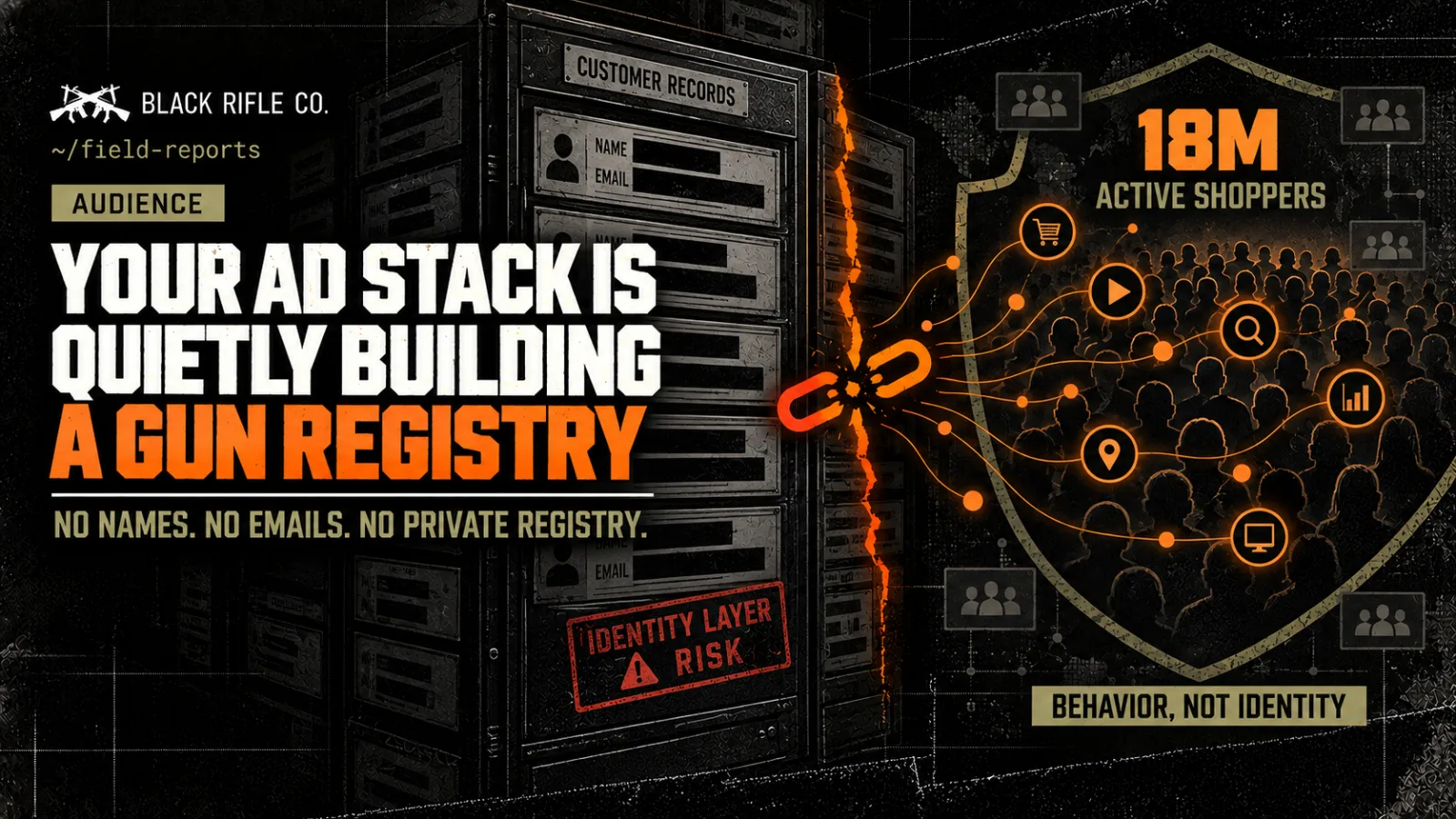
Here is how our stack actually works, because in this category the architecture is the argument. BlackRifle Co. holds no database of gun buyers. Not names, not emails, not hashed versions of either. What we bring is fifteen years of category intelligence: knowing what a serious buyer reads, researches, and shops for when he is in market. We use that knowledge to define audiences - behavioral definitions, not lists of people - inside the ad platform that serves the campaigns. What those definitions capture is what 18 million active firearms shoppers read, research, and shop for, and the signals that say "in market right now." We can put your brand in front of them at scale without anyone, including us, knowing who they are.
Inside the platform, the plumbing runs on the ad industry's standard pseudonymous identifiers: cookie IDs and hashed keys. No names. No plaintext contact information. A privacy lawyer will tell you those identifiers still technically count as personal data, and the lawyer is right, which is why we say anonymized rather than magic. The honest version of the claim is this: nothing in the chain contains a name, we never see or store any of it, and the identifiers that do exist are famously noisy - a single browser routinely maps to dozens of hashed keys. Attribution vendors hate that fog. Your customers should love it.
Walk the liabilities back through that. A breach of our agency yields no customer list, because we do not hold one. A subpoena served on us produces the same. And what lives in the platform reads nothing like the artifact this industry organized itself to prevent: behavior attached to disposable IDs, not names attached to purchases.
And the audience is not smaller for the sacrifice. It is bigger. Identity-based audiences work worst on exactly this population: the buyer who pays cash and keeps a separate email for gun content is hostile terrain for an identity graph, and in this market he is not the exception, he is the median. Behavior does not hide the way identity does. The audience reaches 18 million precisely because it never needed anyone's name.
Anonymized does not mean unmeasured, either. The 6x return we publish is measured on incremental lift, which is an aggregate question about revenue, not a person-level question about people. You do not need to identify a single buyer to know the campaign moved the number.
Two questions for any vendor
First: can you produce a list of my customers with names attached? Second: if you were breached tomorrow, what would the attacker walk away with? If the answer to the first is yes, they are holding a registry with your logo on it, whatever the deck calls it. If the answer to the second includes identities, the feature on the invoice is the liability.
Our answers are no, and nothing with a name on it. We built the stack that way on purpose. Your customers work hard at not being known. Your ad stack should stop working against them.